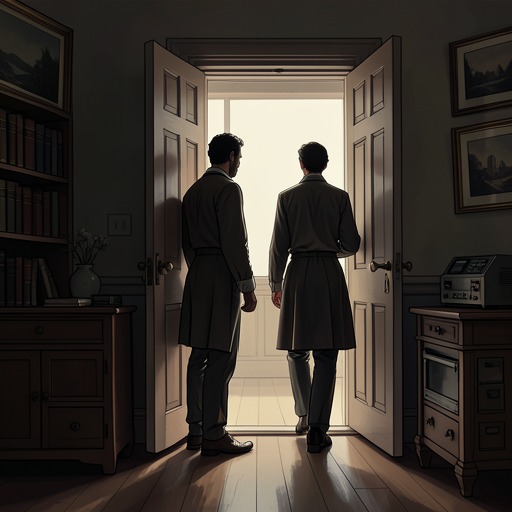
Letters of Florentino Ariza and Fermina Daza
Love in the Time of CholeraFlorentino Ariza and Fermina Daza’s letters are the means by which their first love survives separation, surveillance, and the absence of private conversation. Written in secret and passed through hiding places, the correspondence lets their relationship grow while also preserving its central imbalance: Florentino writes with consuming intensity, while Fermina’s more guarded notes record the ordinary events of her days. The letters become both a record of intimacy and the evidence through which her father eventually exposes it.
The exchange begins
After Fermina promised Florentino an answer before the school vacation ended, Aunt Escolástica helped deliver the first decisive message. She went with Fermina to the telegraph office on the pretext of asking about a telegram to Piedras de Moler, then left behind a breviary containing an envelope of linen paper with golden vignettes. Florentino read the note repeatedly, overcome with joy. The letter opened a correspondence that would give the young lovers a way to communicate despite having no opportunity to speak privately.
Their letters quickly became a daily practice. During the first three months, not a day passed without a message, and for a time they wrote twice a day. Yet the frequency of the exchange did not mean that the two could meet or talk about their love: from their first encounter until Florentino renewed his declaration decades later, they never had the opportunity to be alone together. Writing therefore supplied not just a record of the relationship but its principal form of shared life.
Concealment and contrasting styles
At first, Aunt Escolástica carried messages to the telegraph office through encounters that could pass as casual. As she recognized that Fermina’s attachment was not a passing girlish fancy, she also understood the danger to herself: she depended on her brother’s support and feared his response if he learned she had helped the lovers. She nevertheless could not bring herself to inflict on Fermina the kind of lasting grief she had known in her own youth. The system she helped establish let her niece preserve an appearance of innocence while continuing the exchange.
Fermina left notes in hiding places along her route between home and the Academy, indicating where Florentino could leave his reply. He did the same. Their written path ran through church baptisteries, holes in trees, and recesses in ruined colonial fortresses. Rain, mud, damage, and lost letters repeatedly threatened the messages, but the lovers found ways to resume contact. The exchange was thus sustained by a practical routine as much as by romantic feeling: every letter depended on a concealed location and on the next writer successfully finding it.
The letters also expose a difference in how the two lovers express themselves. Florentino wrote every night, often staying awake until dawn in the back room of his mother’s notions shop. As he tried to imitate poets from the Popular Library, his letters became increasingly discursive and extravagant. Fermina, watched by her father and the nuns, had far less time and privacy. She wrote in the bathroom or while pretending to take notes in class, usually filling no more than half a page. Her messages, in a restrained, practical style likened to a ship’s log, described everyday events and kept the relationship alive without matching Florentino’s emotional outpouring.
Florentino tried to draw Fermina into his more expressive mode. He sent miniature verses inscribed on camellia petals and enclosed a lock of his hair, hoping for a strand from her braid in return. She did not send the response he longed for, but she began to include other small objects: veins of leaves dried in dictionaries, butterfly wings, feathers, and, for his birthday, a square centimeter of Saint Peter Claver’s habit. The exchange made affection tangible through tokens as well as words, even as the different scale of their gestures preserved the distance between his ardor and her caution.
From correspondence to engagement
The lovers’ letters continued through nearly two years of intense correspondence, during which Florentino’s romantic life also brought him into danger. Accused of sending messages to Liberal ships, he spent three nights in the local garrison with irons around his ankles. He later remembered the brief imprisonment as an ordeal endured for love. The correspondence itself became more serious when, in a single-paragraph letter, he formally proposed marriage.
For months before the proposal, Florentino had sent Fermina a white camellia. She returned each flower in her next letter, signaling that she wished to keep writing but did not intend the gesture as an engagement. She had treated the exchange of camellias as a lovers’ game, not as a decision about her future. The formal proposal changed the meaning of the correspondence: Fermina felt its stakes sharply and asked Aunt Escolástica for advice. Her aunt urged her to accept, and Fermina asked for time—first a month, then two, then three. After the fourth month passed without an answer, another camellia arrived with Florentino’s notice that it would be the last.
Fermina’s reply came on a strip torn from the margin of a school notebook. In pencil, she agreed to marry him on the condition that he promise not to make her eat eggplant. The brief note transformed an exchange built on concealed messages into a promise of marriage. Florentino had not expected her answer, but his mother, Tránsito Ariza, had already been preparing for the possibility: months earlier she had begun negotiating to rent more of the house she shared with other families, since their existing rooms were too small for a third person.
Discovery and the letters’ consequences
The correspondence ultimately became the means by which Fermina’s secret was discovered. At the Academy, Sister Franca de la Luz caught Fermina writing a love letter while pretending to take notes. Under the school’s rules, the offense warranted expulsion. Fermina admitted writing the letter but refused to identify her sweetheart, including when questioned by the religious tribunal. The school confirmed her expulsion.
Lorenzo Daza then searched his daughter’s room, which had previously been a private sanctuary. In the false bottom of her trunk he found packets containing three years’ worth of letters. Their signature identified Florentino, but Lorenzo could not accept that Fermina knew so little about him beyond his work as a telegraph operator and his love of the violin. He concluded that his sister must have helped the relationship and sent Fermina away by schooner to San Juan de la Ciénaga. The letters had made the courtship possible; once exposed, they also gave Lorenzo the proof he needed to act against it and to punish the aunt he believed had enabled it.
The correspondence therefore holds together both the tenderness and the vulnerability of the young lovers’ story. It preserves daily contact where speech and privacy are unavailable, and its concealed routes allow affection to continue despite watchful authority. But the written record is also material evidence: the packets hidden in Fermina’s trunk turn a secret shared between two people into a family discovery with lasting consequences. Long after the notes themselves have passed from the immediate exchange, their history marks the relationship’s beginning as a love lived through messages, delay, and the risks of being found.